The Courage to Be Known: How Letting Your Guard Down Transforms Companionship Into Something Profound
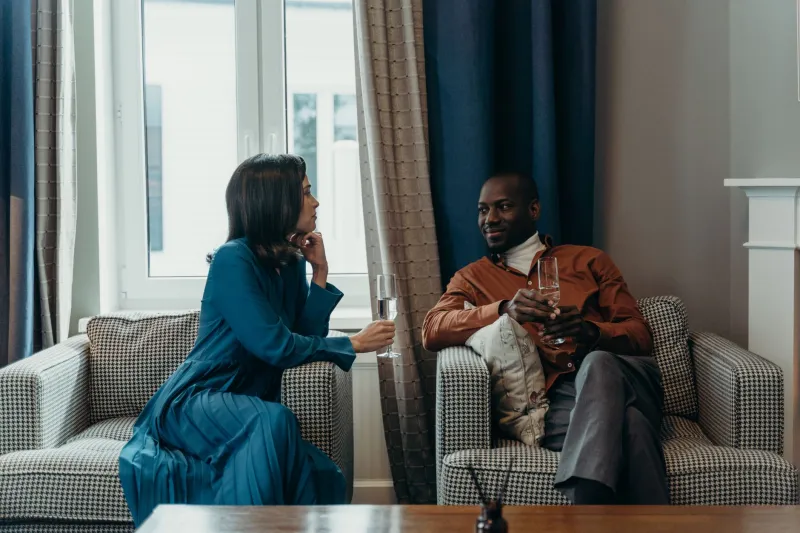
There is a particular kind of loneliness that has nothing to do with being alone. It surfaces in rooms full of people, during polished conversations, and even in the company of someone attentive and warm — when the version of yourself you've brought to the table isn't quite the real one. Many clients who seek companionship services arrive carrying precisely this weight: the habit of presenting a curated self, one scrubbed of uncertainty, softened of need, and edited of anything that might seem too raw or too real.
What gets lost in that editing, however, is often the very thing that makes connection worthwhile.
The Performance That Costs You the Experience
American culture places a premium on confidence, composure, and self-sufficiency. From the boardroom to the bar, the expectation is that a person arrives assembled — certain of what they want, comfortable in their own skin, and unbothered by the messiness of being human. This cultural conditioning follows clients into companionship encounters, where many instinctively default to a kind of social performance: projecting ease they don't entirely feel, projecting desire that may not reflect what they actually want, and concealing the softer, less certain parts of themselves.
The irony is significant. By working so hard to appear impressive, many clients inadvertently prevent the very connection they came seeking. A companion reading a performance cannot respond to a person. And an encounter built on managed impressions tends to leave both parties feeling — however subtly — as though they've been present without truly arriving.
What Vulnerability Actually Looks Like in This Context
Vulnerability, as it applies to companionship, is frequently misunderstood. It does not require emotional disclosure, confession, or any form of oversharing. It is not about unburdening yourself or turning an encounter into a therapy session. In this context, vulnerability is something quieter and more precise: it is the willingness to be honest about what you actually want, what genuinely brings you pleasure, what kind of conversation feeds you, and what kind of presence you find comforting.
It might look like admitting that you'd prefer a quiet evening over a busy social setting, even if you assumed your companion would expect otherwise. It might mean acknowledging that you're navigating a stressful period in your life rather than pretending everything is fine. It might simply mean expressing a preference — for a particular kind of humor, for physical proximity without pressure, for intellectual conversation over small talk — without dressing it up or hedging it away.
These small acts of honesty are not weaknesses. They are the raw material from which genuinely satisfying encounters are built.
The Psychology Behind the Reluctance
Understanding why vulnerability feels risky is worth a moment's attention, because the hesitation is rarely irrational — it is simply misdirected. Most people have learned through social experience that revealing too much, too soon, or in the wrong context, invites judgment or rejection. That lesson is appropriate in many settings. It becomes counterproductive in the context of companionship, where the professional on the other side of the arrangement is specifically skilled at receiving honesty without judgment.
Fear of appearing weak is perhaps the most common barrier. Many clients — particularly those accustomed to positions of authority or social standing — find it genuinely uncomfortable to occupy a space where they are not in complete control of their own image. There is also the fear of being misread: that expressing a softer need will be interpreted as desperation, or that admitting uncertainty will undermine the dynamic they hoped to establish.
What these fears share is an assumption that vulnerability diminishes standing. In companionship, the opposite tends to be true. A client who communicates honestly is easier to serve well, more satisfying to engage with, and far more likely to leave the encounter feeling that something real occurred.
How Openness Changes the Dynamic for Both Parties
Seasoned companions consistently note that their most memorable and rewarding professional experiences involve clients who were willing to be present in an unguarded way. This is not simply a matter of personal preference — it is a functional reality. When a client offers honest signals about what they enjoy, what makes them uncomfortable, and what they genuinely hope to experience, a skilled companion can calibrate accordingly. The result is an encounter that feels tailored rather than generic, responsive rather than scripted.
This dynamic works in both directions. A client who brings authenticity to an encounter creates the conditions under which a companion can also be more genuinely engaged. Connection, even in a professional context, is rarely one-directional. When one person in the room drops the performance, the atmosphere changes — it becomes safer, warmer, and more conducive to the kind of presence that makes time together feel significant.
Practical Steps Toward Showing Up More Honestly
For those who find vulnerability unfamiliar or uncomfortable, the shift need not be dramatic. A few deliberate choices can meaningfully change the quality of an encounter:
Communicate preferences before the meeting. Many of the most useful disclosures happen in the planning stage. If you know you find certain social settings draining, that you prefer a particular conversational register, or that you're navigating something difficult in your personal life, sharing that context in advance allows your companion to arrive prepared rather than guessing.
Release the obligation to perform. It is worth reminding yourself, particularly in the early moments of an encounter, that the purpose of the time you've arranged is not to impress. You have already made the arrangements. The encounter now belongs to you — and the most valuable thing you can bring to it is yourself.
Notice when you're editing. Many people are so habituated to self-presentation that they don't recognize when they're doing it. If you catch yourself deflecting a question, minimizing a preference, or performing an emotion you don't quite feel, treat that as information. You don't have to act on every observation immediately, but awareness is the first step toward a different approach.
Allow the encounter to unfold. Some of the most meaningful moments in companionship happen in the unplanned spaces — in a conversation that goes somewhere unexpected, in a quiet that turns out to be comfortable rather than awkward. These moments are far more likely to occur when both parties have been given permission to be present rather than performative.
The Deeper Reward
There is a reason that the most frequently cited quality of exceptional companionship experiences is not luxury, not physical attraction, and not any particular activity — it is the feeling of having been genuinely known, even briefly, by another person. That feeling cannot be manufactured through performance. It emerges only when something true has been offered and received.
The courage to show up as you actually are — with your preferences and your uncertainties, your desires and your quiet needs — is not a vulnerability in the diminishing sense. It is, in fact, the most sophisticated thing a client can bring to a companionship encounter. And it is almost always the thing that makes the difference between an experience that was pleasant and one that was genuinely worth having.